Data Privacy Laws 2026: Small Business Compliance Guide

Anúncios
Navigating Data Privacy Laws for Small Businesses: Compliance in a 2026 Digital World
In an increasingly interconnected digital landscape, data has become the new oil – a valuable commodity that drives innovation, personalizes experiences, and fuels economic growth. However, with this immense value comes an equally immense responsibility: safeguarding individual privacy. For small businesses, the challenge of navigating the intricate web of data privacy compliance is growing more complex year by year, and 2026 is poised to bring further evolution and stricter enforcement of data privacy laws.
Anúncios
Many small business owners often feel overwhelmed by the sheer volume and complexity of data protection regulations. From the European Union’s GDPR to California’s CCPA, and a growing number of state and international laws, understanding what applies to your business and how to achieve compliance can seem like a monumental task. Yet, ignoring these regulations is not an option. Non-compliance can lead to hefty fines, reputational damage, loss of customer trust, and even legal action, all of which can be catastrophic for a small enterprise.
This comprehensive guide is designed to demystify data privacy laws for small businesses in the context of 2026. We will explore the current landscape, anticipate future trends, and provide actionable strategies to help your business not only comply but also thrive in a privacy-first world. Our focus is on practical, implementable steps that even businesses with limited resources can adopt, ensuring your operations are secure, ethical, and legally sound.
Anúncios
The Evolving Landscape of Data Privacy Laws in 2026
The regulatory environment surrounding data privacy is dynamic, constantly adapting to technological advancements and societal expectations. What was considered sufficient compliance a few years ago might be outdated by 2026. Small businesses must remain vigilant and proactive in their approach to data privacy compliance.
Global Influences and Local Adaptations
While the General Data Protection Regulation (GDPR) in the EU and the California Consumer Privacy Act (CCPA) and its successor, the California Privacy Rights Act (CPRA), remain benchmarks, numerous other jurisdictions are enacting or updating their own comprehensive data privacy frameworks. These include laws in Canada (PIPEDA, CPPA), Brazil (LGPD), Australia (Privacy Act), and an increasing number of US states beyond California, such as Virginia (CDPA), Colorado (CPA), Utah (UCPA), and Connecticut (CTDPA). By 2026, we can expect several more states to have their own privacy laws in effect, creating a patchwork of regulations that small businesses must navigate.
The key challenge for small businesses operating nationally or internationally is identifying which laws apply to them. Jurisdiction often depends on where your customers are located, not just where your business is headquartered. This means a small online retailer based in Ohio could still be subject to California’s CCPA if they collect data from California residents, or even GDPR if they serve customers in the EU.
Key Trends to Watch for in 2026
- Increased Enforcement: Regulators are becoming more sophisticated and assertive in enforcing data privacy laws. Fines are increasing, and authorities are more willing to pursue legal action against non-compliant entities, regardless of size.
- Focus on AI and Automated Decision-Making: As artificial intelligence becomes more pervasive, regulators are scrutinizing how AI systems collect, process, and use personal data, especially in automated decision-making processes that can impact individuals’ rights. Small businesses utilizing AI tools must ensure transparency and fairness.
- Data Localization Requirements: Some countries are implementing data localization laws, requiring certain types of data to be stored and processed within their borders. This can add complexity for small businesses using cloud services or international data transfers.
- Enhanced Individual Rights: Consumers are gaining more control over their data. Expect expanded rights concerning data access, deletion, correction, and portability, alongside easier mechanisms for exercising these rights.
- Supply Chain Accountability: Businesses are increasingly held responsible for the data privacy practices of their vendors and third-party service providers. Small businesses must implement robust vendor management programs to ensure their partners are also compliant.
- Privacy by Design and Default: This principle, already central to GDPR, will likely become a global standard. It mandates that privacy considerations are embedded into the design of systems, products, and services from the outset, rather than being an afterthought.
Understanding Your Data: The Foundation of Compliance
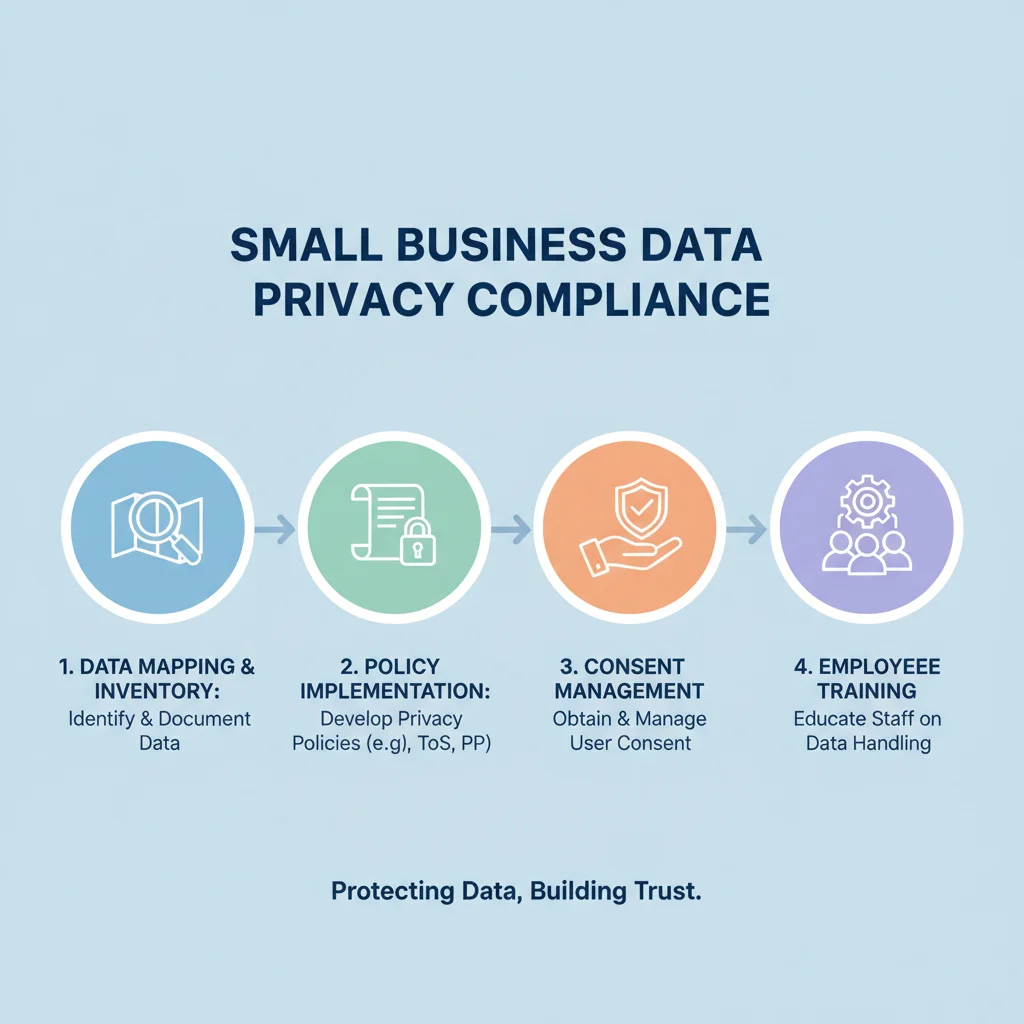
Before you can comply with data privacy compliance, you need to understand what data you collect, why you collect it, where it’s stored, and who has access to it. This process is often referred to as data mapping or data inventory.
Conducting a Data Inventory (Data Mapping)
A thorough data inventory is the cornerstone of any effective data privacy program. It involves:
- Identifying Personal Data: List all types of personal data your business collects (e.g., names, email addresses, IP addresses, browsing history, payment information, health data, employee records).
- Sources of Data: Determine how and from where this data is collected (e.g., website forms, customer surveys, marketing analytics, third-party integrations, HR systems).
- Purpose of Collection: Clearly define why each piece of data is collected. Is it necessary for fulfilling a contract, for legitimate business interests, or based on explicit consent?
- Storage Locations: Document where the data is stored (e.g., local servers, cloud services like AWS or Google Cloud, CRM systems, email marketing platforms).
- Data Flows and Transfers: Map out how data moves within your organization and to third parties (e.g., payment processors, marketing agencies, shipping partners). Identify any international data transfers.
- Retention Periods: Establish how long you need to keep each type of data, based on legal requirements, contractual obligations, and business needs.
- Access Controls: Identify who within your organization has access to different types of personal data and why.
This exercise might seem daunting, but tools and templates are available to assist small businesses. The goal is to gain a clear, comprehensive picture of your data ecosystem. Without this understanding, attempting to implement data privacy compliance measures is like trying to navigate a maze blindfolded.
Key Principles of Data Privacy Compliance for Small Businesses
While specific regulations vary, several core principles underpin most data privacy laws. Adhering to these principles will significantly strengthen your overall data privacy compliance posture.
1. Lawfulness, Fairness, and Transparency
- Lawfulness: Ensure you have a valid legal basis for processing personal data (e.g., consent, contractual necessity, legal obligation, legitimate interest).
- Fairness: Process data in a way that is fair to the individuals concerned. Do not mislead them about how their data will be used.
- Transparency: Be clear and open with individuals about how their data is collected, used, shared, and protected. This is primarily achieved through clear and accessible privacy policies.
2. Purpose Limitation
Collect data only for specified, explicit, and legitimate purposes, and do not further process it in a manner that is incompatible with those purposes. Avoid collecting data ‘just in case’ you might need it later.
3. Data Minimization
Collect only the personal data that is necessary for your stated purpose. The less data you collect, the lower your risk profile. Regularly review your data collection practices to ensure you are not over-collecting.
4. Accuracy
Take reasonable steps to ensure that personal data is accurate, complete, and up-to-date. Establish processes for individuals to correct inaccurate data.
5. Storage Limitation
Keep personal data for no longer than is necessary for the purposes for which it was collected. Implement data retention policies and securely delete or anonymize data once its purpose has been fulfilled.
6. Integrity and Confidentiality (Security)
Implement appropriate technical and organizational measures to ensure the security of personal data, protecting it against unauthorized or unlawful processing and against accidental loss, destruction, or damage. This is a critical aspect of data privacy compliance.
7. Accountability
Be able to demonstrate compliance with these principles. This includes maintaining records of processing activities, conducting data protection impact assessments where necessary, and implementing appropriate governance structures.
Practical Strategies for Small Business Data Privacy Compliance in 2026
Implementing Effective Data Privacy Compliance Strategies
Now that we’ve covered the foundational principles, let’s delve into practical steps your small business can take to achieve and maintain data privacy compliance by 2026.
1. Update Your Privacy Policy and Terms of Service
Your privacy policy is the cornerstone of transparency. It must be:
- Clear and Concise: Avoid legal jargon where possible. Use plain language that your customers can easily understand.
- Comprehensive: Detail what data you collect, why you collect it, how you use it, who you share it with, how long you retain it, and how individuals can exercise their rights.
- Accessible: Make it easy to find on your website or within your applications.
- Up-to-Date: Regularly review and update your policy to reflect changes in your data processing activities or new legal requirements.
The terms of service should also reflect your data handling practices and any specific consent mechanisms.
2. Implement Robust Consent Management
Consent is a vital legal basis for data processing under many privacy laws. Ensure your consent mechanisms are:
- Freely Given: Individuals must have a genuine choice, without coercion.
- Specific: Consent should be for a specific purpose (e.g., ‘send me marketing emails about new products,’ not just ‘receive communications’).
- Informed: Individuals must understand what they are consenting to.
- Unambiguous: Use clear affirmative action (e.g., ticking an unchecked box), not pre-ticked boxes or implied consent.
- Easy to Withdraw: Provide a simple mechanism for individuals to withdraw consent at any time.
- Recordable: Maintain records of when and how consent was obtained.
Consider using a Consent Management Platform (CMP) for website cookies and tracking technologies, especially if you have an international audience.
3. Strengthen Data Security Measures
Security is paramount to data privacy. Small businesses should implement:
- Access Controls: Limit access to personal data to only those employees who need it for their job functions. Use strong passwords, multi-factor authentication (MFA), and role-based access.
- Encryption: Encrypt sensitive data both in transit (e.g., using SSL/TLS for website traffic) and at rest (e.g., encrypting hard drives or cloud storage).
- Regular Backups: Implement a robust data backup and recovery plan to prevent data loss.
- Firewalls and Antivirus: Maintain up-to-date firewalls and antivirus/anti-malware software on all systems.
- Secure Software Development: If you develop your own software or applications, integrate security best practices into the development lifecycle.
- Physical Security: Secure physical access to servers and devices containing personal data.
- Incident Response Plan: Develop a plan for responding to data breaches, including notification procedures to affected individuals and regulatory authorities.
4. Conduct Data Protection Impact Assessments (DPIAs)
For new projects, systems, or significant changes to data processing activities that are likely to result in a high risk to individuals’ rights and freedoms, conduct a DPIA. This involves:
- Describing the processing operation and its purposes.
- Assessing the necessity and proportionality of the processing.
- Assessing the risks to individuals’ rights and freedoms.
- Identifying measures to address those risks.
While not always mandatory for every small business activity, performing DPIAs as part of your data privacy compliance efforts demonstrates a proactive approach to risk management.
5. Manage Third-Party Vendors and Data Processors
You are responsible for the data you share with third parties. Ensure that:
- Due Diligence: Vet all vendors who will process personal data on your behalf. Understand their security measures and compliance posture.
- Data Processing Agreements (DPAs): Put legally binding contracts (DPAs or similar agreements) in place that clearly define the roles and responsibilities of both parties regarding data protection. These agreements should specify how data is processed, secured, and returned or deleted.
- Regular Audits: Periodically review your vendors’ compliance and security practices.
6. Train Your Employees
Human error is a leading cause of data breaches. Regular, mandatory data privacy training for all employees is crucial. Training should cover:
- The importance of data privacy compliance.
- Your company’s specific data handling policies and procedures.
- How to identify and report suspicious activities (e.g., phishing attempts).
- The rights of data subjects and how to handle data subject requests.
- Best practices for password security, email hygiene, and secure data storage.
Make training engaging and relevant to their roles. Refresher courses should be conducted annually or whenever there are significant changes to laws or internal policies.

7. Establish Data Subject Request Procedures
Individuals have rights concerning their personal data, such as the right to access, rectify, erase, restrict processing, and port their data. Your small business needs clear, efficient procedures to handle these requests within the legally mandated timeframes. This includes:
- Designated Contact: Provide a clear point of contact (e.g., a dedicated email address) for data subject requests.
- Verification Process: Implement a process to verify the identity of the requester to prevent unauthorized access to data.
- Internal Workflow: Establish an internal workflow for receiving, tracking, and fulfilling requests.
- Timelines: Be aware of and adhere to the response timelines stipulated by applicable laws (e.g., 30 days under GDPR).
8. Appoint a Data Protection Officer (DPO) or Privacy Lead
While not all small businesses are legally required to appoint a DPO, designating an individual or a small team to oversee data privacy efforts is highly recommended. This person or team would be responsible for:
- Monitoring data privacy compliance.
- Advising on data protection impact assessments.
- Liaising with supervisory authorities.
- Handling data subject requests.
- Providing internal training and awareness.
For very small businesses, this role might be combined with other responsibilities, but the key is to have clear accountability for data privacy.
Challenges and Opportunities for Small Businesses in 2026
Common Challenges
- Resource Constraints: Small businesses often lack the dedicated legal and IT resources of larger enterprises.
- Complexity of Laws: The sheer number and varying requirements of global and state-level laws can be overwhelming.
- Keeping Up with Changes: Data privacy regulations are constantly evolving, requiring continuous monitoring and adaptation.
- Vendor Management: Ensuring all third-party vendors are compliant adds another layer of complexity.
Opportunities in Compliance
Viewing data privacy compliance as merely a burden misses significant opportunities:
- Enhanced Customer Trust: Demonstrating a strong commitment to data privacy builds trust and loyalty, differentiating your business from competitors.
- Improved Data Management: Compliance efforts lead to better internal data hygiene, reducing inefficiencies and risks.
- Reduced Risk of Breaches: Robust security and privacy measures significantly lower the likelihood and impact of data breaches.
- Competitive Advantage: For businesses operating in sectors where privacy is a major concern, strong compliance can be a key selling point.
- Future-Proofing: Proactive compliance helps your business adapt more easily to future regulatory changes.
Tools and Resources for Small Business Data Privacy Compliance
Fortunately, small businesses don’t have to navigate this landscape alone. A growing ecosystem of tools and resources can aid in achieving data privacy compliance:
- Privacy Management Software: Platforms like OneTrust, TrustArc, or smaller, more affordable options can help with data mapping, consent management, DPIAs, and data subject request handling.
- Legal Counsel: Consulting with a lawyer specializing in data privacy is invaluable, especially for interpreting complex regulations and drafting policies.
- Cybersecurity Solutions: Invest in reputable antivirus, firewall, and intrusion detection systems. Consider managed security services if internal IT resources are limited.
- Industry Associations: Many industry-specific associations offer guidance and resources tailored to their members’ compliance needs.
- Government Resources: Regulatory bodies often publish guides and FAQs for small businesses (e.g., ICO for GDPR, Attorney General’s office for state privacy laws).
- Templates and Checklists: Utilize readily available templates for privacy policies, data processing agreements, and data inventory checklists.
Conclusion: Embracing a Privacy-First Future
The journey to full data privacy compliance is ongoing, not a one-time event. For small businesses, 2026 represents a critical juncture where proactive measures will define success and resilience. By understanding the evolving legal landscape, committing to core privacy principles, and implementing practical strategies, your business can not only avoid penalties but also build a stronger foundation of trust with your customers.
Embrace data privacy not as a burden, but as an opportunity to demonstrate your commitment to ethical data handling and customer protection. In a world increasingly concerned about digital rights, being a privacy-conscious small business will be a significant competitive advantage, fostering loyalty and driving sustainable growth. Start today by assessing your current data practices, educating your team, and building a culture where data privacy is everyone’s responsibility.
Remember, the goal is not just to comply with the letter of the law, but to embody the spirit of privacy – respecting individuals’ data as if it were your own most valuable asset. This approach will position your small business for success well beyond 2026.